Vectis Commerce Platform
Vectis is a B2B-first headless commerce platform built with Python (FastAPI), SvelteKit, PostgreSQL, Redpanda, and Temporal. It replaces a legacy WooCommerce stack with a purpose-built system for wholesale and hybrid B2B/B2C commerce.
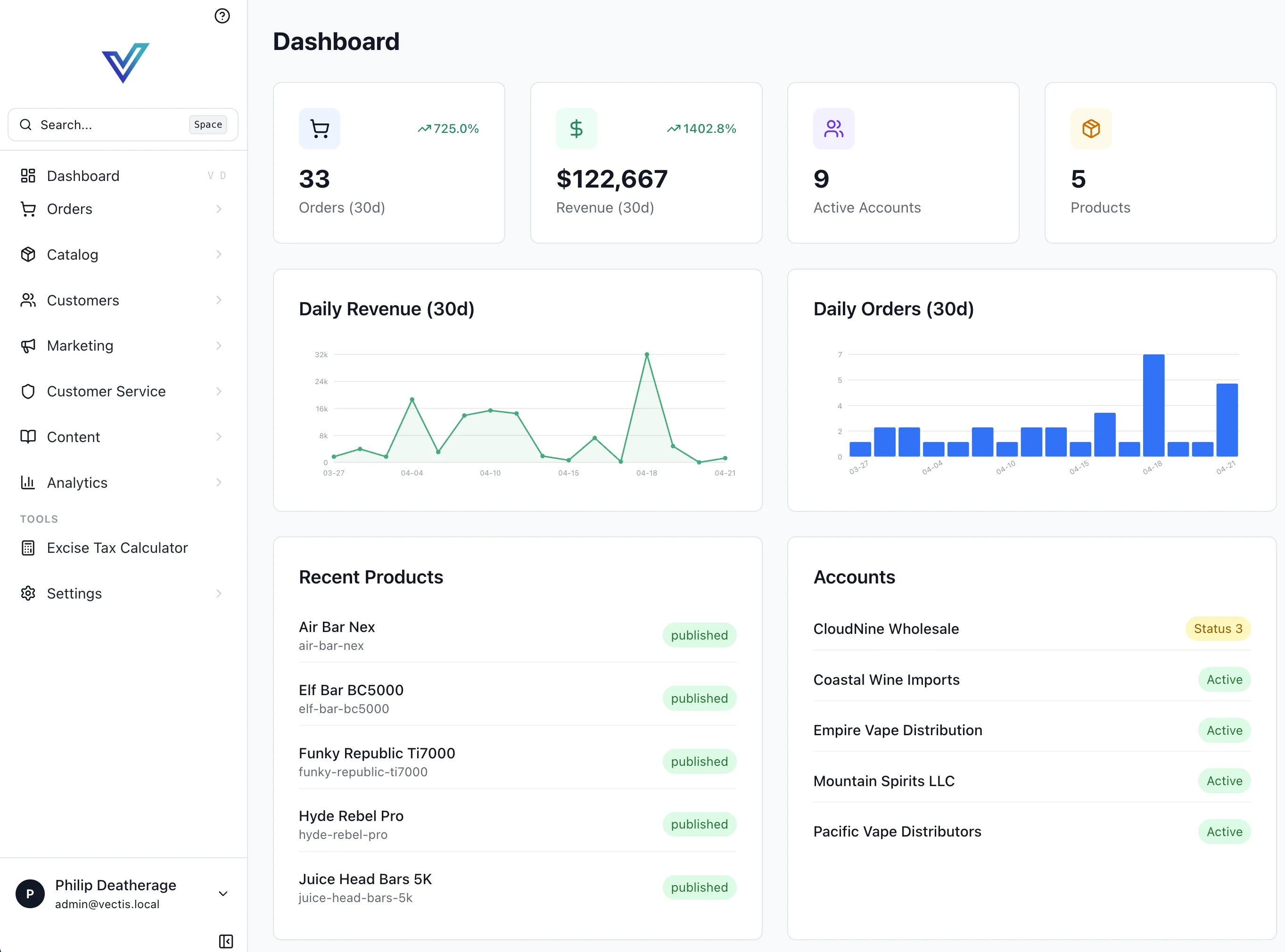
Key Capabilities
- B2B + B2C in one platform — channel-based commerce modes (wholesale, retail, hybrid)
- Four-phase B2B approval workflow — cart submitted → cart approved → payment composed → payment approved → place order, with durable Temporal execution and a workflow-fault inbox
- Eight-level pricing — managed cart prices, location- and customer-owned price lists, customer/group category overrides, assigned lists, group pricing, and default tiers, with multi-currency support
- Packaging + MMOQ — global package ladders (
each,case-of-24), per-customer min/max enforced at the cart aggregate, channel-timezone-aware 30-day windows - Inventory state machine — reservation lifecycle (
HELD → CONFIRMED → RELEASED / EXPIRED),pushExternalStockfor ERP feeds, external fulfillment handoff with internal-hold release - Configurable order state machine — transitions, guards, and side-effects defined per deployment
- True extension platform — strategy-mediated business logic with self-registration (Cmd-K, nav, GraphQL, models, schedules, search), a frozen
vectis_sdkimport surface, per-extension migrations, a registration ledger with automatic cleanup, and channel-scoped activation; guards enforce zero core↔extension imports in both directions - Refund approval workflow — async, durable, per-tender progress tracking with idempotent retry
- Event-driven architecture — in-process EventBus + Redpanda for inter-service communication, JSON-Schema-validated payloads, dedicated workflow-fault topic
- Durable workflows — Temporal for order lifecycle, recurring orders, approvals, refunds, and all background tasks
- Observability baseline —
/metrics(Prometheus) +/ready(parallel dependency probe) with a seeded Grafana dashboard
Quick Links
| I want to... | Go to... |
|---|---|
| Set up a local dev environment | Quick Start |
| Understand the architecture | Architecture |
| Add a backend module | Modules Guide |
| Build an extension | Extensions Guide |
| Work with the GraphQL API | API Overview |
| Understand the order flow | Orders |
| Set up pricing and currencies | Pricing |
| Run a referral/affiliate program | Affiliates |
| Configure a points program | Loyalty |
| Pull revenue & campaign reports | Analytics |
| Deploy to production | Deployment |
Tech Stack
| Layer | Technology |
|---|---|
| Backend API | Python 3.12, FastAPI, SQLAlchemy 2.0 (async), Strawberry GraphQL |
| Storefront | SvelteKit 2, Tailwind CSS, Lucide icons |
| Admin Panel | SvelteKit 2, Tailwind CSS, Lucide icons |
| Database | PostgreSQL 18 |
| Cache / Sessions | Valkey 9 (Redis-compatible) |
| Event Streaming | Redpanda (Kafka-compatible) |
| Workflows | Temporal |
| Search | Meilisearch (admin) + Typesense (storefront); pluggable engines incl. Algolia |
| Object Storage | S3-compatible (RustFS in dev) |
Licensing
Vectis Commerce is a commercial product. The core engine, the admin/storefront shells, the 48 first-party extensions, and the hosted cloud are proprietary and paid — delivered as cloud SaaS first, with licensed self-hosting to follow. The developer surface is open and Apache-2.0 licensed: vectis_sdk (the frozen API facade), vectis_testkit (contract suites + fixtures), the public vectis-ext-example, and the extension documentation — these are the only artifacts published to public PyPI. Third-party extensions are authored against the open SDK and may be free or commercial; running them requires a licensed core.
Project Status
The platform is in active development. All strategy interfaces are implemented, 53 core modules are built, 48 first-party extensions are maintained in the companion enterprise-extensions repository, and the end-to-end checkout pipeline (tax, shipping, payment, promotions, approvals) is wired with the four-phase B2B workflow. The admin/storefront are fully migrated to Houdini for GraphQL, and make check (~2,260 tests + ruff + mypy + AST guards + lock/sync/model-drift/schema-drift gates) is the single source of truth for "is this branch safe to push?".
GitHub Actions CI is currently disabled (2026-05-18) in favour of the local gate. See the Changelog for the per-phase status, including the recent extension-platform, pricing, channels, and admin-IA cycles.