Building Extensions
Extensions add capabilities — payment gateways, tax providers, shipping carriers — without modifying the core engine. They are installed as Python packages and discovered automatically at startup via entry points. Extensions live outside the core repository: the first-party set ships from the vectiscommerce/enterprise-extensions repo, third-party extensions from their own repos, and in development the core discovers a checkout via the $VECTIS_DEV_EXTENSIONS dev-link (see Discovery). The in-tree backend/vectis/extensions/ directory contains only the namespace __init__.py — the core is extension-agnostic in-tree.
Looking for per-extension usage docs?
This page is the extension authoring guide. Setup steps, configuration references, and operational notes for every first-party extension live in the Extensions section — one page per extension, served at https://docs.vectisb2b.com/extensions/<id>/, which is where each manifest's docs_url points.
True Extension Platform (shipped 2026-07-02)
The extension contract was hardened in the True Extension Platform wave. The load-bearing rules, each covered in its own section below:
- Canonical ids — the extension id is the directory name minus
ext_; entry-point keys use the bare id. - Module-level manifest —
manifest = ExtensionManifest(...)must be a module-level constant inextension.py. - Register in
on_activate— all registrations are ledgered to the activating extension and auto-unregistered on deactivate/uninstall. - Import
vectis_sdk.*only — new extensions may not importvectis.core/vectis.modules(frozen shrink-only allowlist). - Own your migrations — extension-owned tables use the
ext_<name>_prefix and ship a per-extension Alembic chain as package data. extensions.lock— adding/removing/version-bumping an extension requiresmake lock-extensions.- Sync v2 — extension admin and storefront UI is mirrored by
make sync-extensions; production builds go throughmake prod-build.
Contributing admin UI?
Adding sidebar entries, dashboard widgets, entity tabs, list columns, or settings panels is the admin contribution bus's job — see Admin Contributions for the contribution bus, the 14 descriptor kinds, the extensionDataset / extensionAction wire, and the permission model.
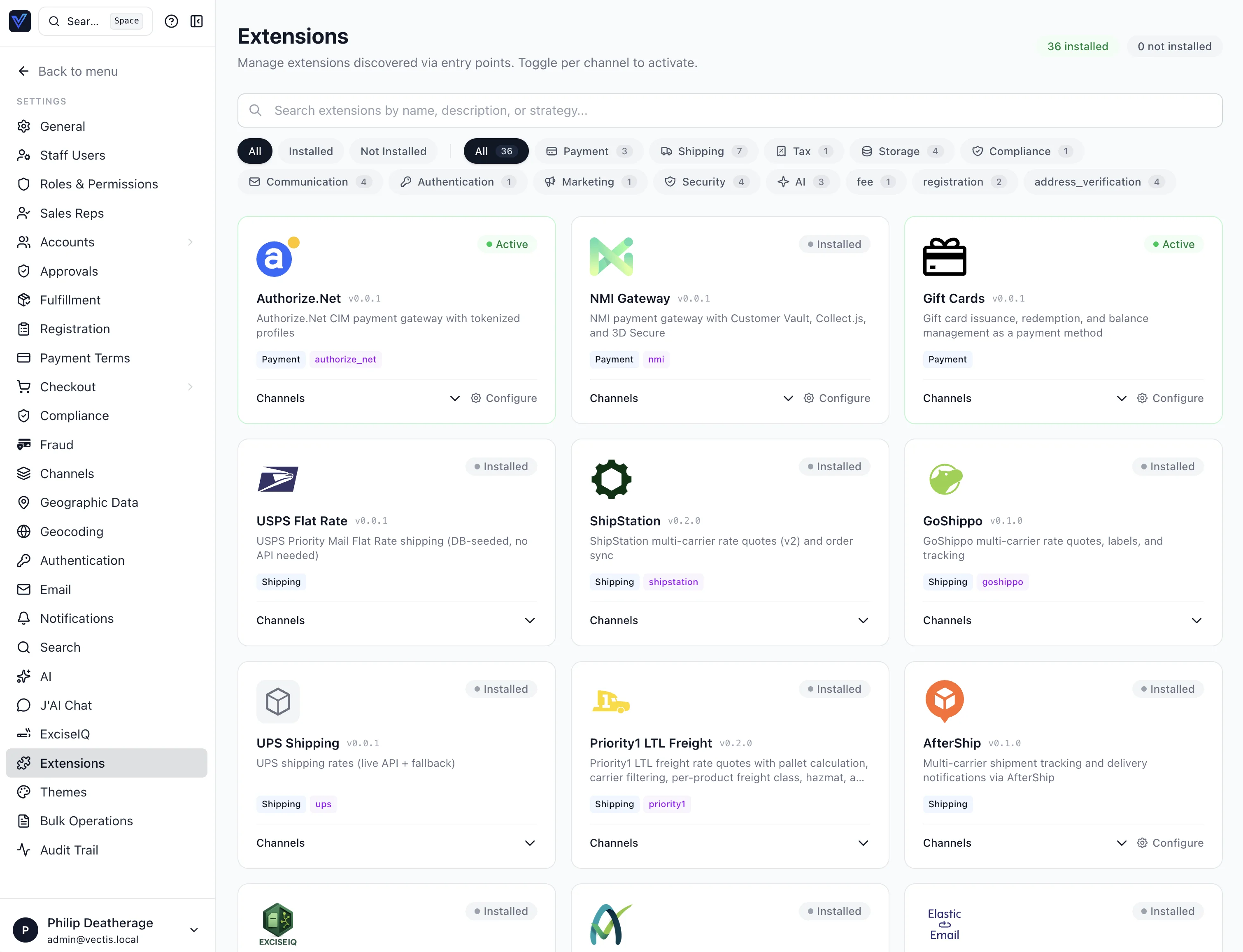
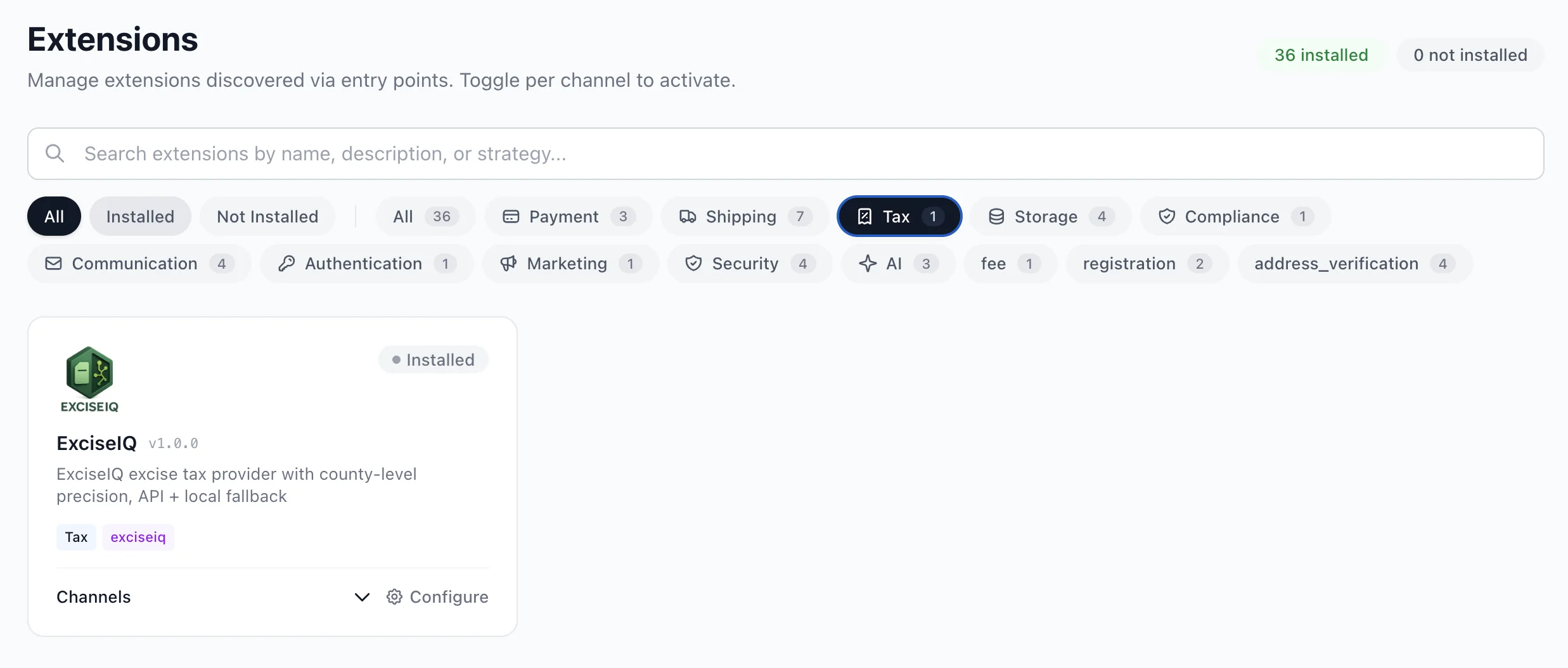
Filter by strategy category to see what's wired up for a domain — tax, for example:
Extension Structure
ext_authorize_net/
├── __init__.py
├── pyproject.toml  # the extension's own installable identity + entry point
├── extension.py    # module-level `manifest` + extension class (lifecycle hooks)
├── strategy.py     # Strategy implementations
└── resolvers.py    # GraphQL resolvers (saved cards, admin transactions)
Extensions that own database tables also ship a migrations/versions/ package-data directory (see Per-Extension Migrations), and extensions with admin/storefront UI ship admin/, admin_pages/, storefront/, and/or storefront_pages/ directories (see Extension UI Sync v2).
Building an extension as its own wheel?
An extension can carry its own pyproject.toml and be built + installed as a standalone wheel that activates via its entry point — with no core edit. The include globs must match the surfaces above (an admin-carrying ext needs .svelte/.ts globs, not just *.py). See Extension Packaging & Extraction.
ext_elastic_email follows the same layout (__init__.py, extension.py, strategy.py): it declares an ExtensionManifest with config_schema for the Elastic Email API and provides ElasticEmailStrategy, an EmailDeliveryStrategy implementation (the ABC is re-exported from vectis_sdk.strategies). Wire it where notification delivery is resolved (e.g. admin email settings), using channel extension config for api_key, default_from_email, default_from_name, and api_url.
Canonical Extension Ids
The canonical extension id is the package directory name with the ext_ prefix stripped: ext_shopify → shopify, ext_authorize_net → authorize_net. The id must match ^[a-z][a-z0-9_]{1,40}$ — lowercase, starts with a letter, then letters/digits/underscores.
Three things must agree on this id:
- The directory name (
ext_<id>/). -
The entry-point key in the extension's own
pyproject.toml— the bare id, not theext_-prefixed directory name: -
The extension class's
nameattribute and the manifest'snamefield.
Legacy variants (ext-excise-engine-style hyphenated names, ext_-prefixed declared names) are coerced to the canonical id with a warning at registration; a declared name that collides with an already-registered canonical id is refused — the duplicate is skipped and logged. Don't rely on the coercion for new extensions: use the canonical id everywhere.
How Extensions Contribute
Vectis enforces a strict separation between core and extensions, guarded in both directions by make check:
- Core modules must never
import ext_*— AST guard atbackend/scripts/check_no_core_extension_imports.py. - Extensions must import
vectis_sdk.*only —backend/scripts/check_extension_imports.pyfreezes legacyvectis.core/vectis.modulesimports to a shrink-only allowlist (see Thevectis_sdkImport Surface).
Extensions contribute through three distinct mechanisms — pick the right one for the contribution:
1. Module-level ExtensionManifest — metadata + admin UI
Every extension must expose a module-level constant in extension.py:
The registry reads it via scan_manifests() before activation, so manifest metadata (including depends_on) is available even for extensions that are installed but not yet active. Calling registry.register_manifest(...) inside on_activate is still supported as an idempotent re-registration, but it is no longer where the manifest lives. There is no separate catalog module — the manifest is the only metadata source; catalog entries for known-but-not-installed extensions live in backend/vectis/core/extension_index.json.
The manifest fields below are declarative — the core engine reads them later (over GraphQL, in the admin layout, in the schedule runner) without ever importing your extension by name.
| Manifest field | What it contributes |
|---|---|
category | One of payment, shipping, tax, compliance, communication, authentication, marketing (others used in practice — fulfillment, ai, support — pass through but aren't in the validated tuple yet) |
strategies | Names of strategies this extension registers via strategy_resolver (used by admin filters) |
depends_on / conflicts_with | Other extension names that must (or must not) be active. Missing deps → activation skipped with a warning |
config_schema | JSON schema for the generic Configure modal in the admin |
permissions | Permission codenames introduced by the extension — upserted into the permissions table at every api boot (see Boot-Time Permission Sync) |
admin_contributions | Unified admin contribution bus — {slot, kind, payload, order?, permission?} entries served over the adminContributions root query; supersedes the individual admin_nav_items / admin_quick_actions / admin_page_tabs fields |
storefront_contributions | Customer-facing contribution bus — {slot, kind, payload, order?, when?} entries served over the storefrontContributions root query |
display_name, icon_light, icon_dark | Admin presentation |
install_hint | Short text rendered on the not-installed catalog card telling the operator how to install |
docs_url | Absolute URL of the extension's documentation page. First-party extensions point at this site: https://docs.vectisb2b.com/extensions/<id-with-hyphens>/ (a relative /docs/... value would resolve against the admin's own domain) |
admin_nav_items | Sidebar entries — {href, label, section, icon_name, permission?}. section matches a sidebar group; icon_name is mapped explicitly in +layout.svelte |
admin_quick_actions | Cmd-K palette entries — {href, label, icon_name, permission?} |
admin_page_tabs | Tabs grafted onto an existing admin page — {page, label, href, icon_name?, permission?} |
admin_settings_pages | Deep-link target for the Configure button on /settings/extensions — the first entry's path is the extension's settings link |
admin_tabs | Tabs on entity-detail pages |
admin_pages, admin_widgets, admin_list_columns, admin_action_bar_items, admin_bulk_actions, admin_form_fields, admin_filters | Other admin slot contributions |
custom_field_definitions | Custom fields per entity type. On registration these flow through custom_field_registry automatically |
EXTENSION_CATEGORIES lives in vectis/core/extension.py and is the validated tuple — passing a category not in the tuple is currently silently accepted (no validator), but new categories should be added there before use.
2. Methods on the extension class — functional contributions
Some contributions need actual Python objects (workflow classes, activity callables, GraphQL resolver classes, SQLAlchemy models). For these, declare a method on your extension class that returns the contribution. The registry iterates these lazily from the loaded extensions.
| Method | Returns | Consumed by |
|---|---|---|
def workflows(self) -> list[type] | Temporal @workflow.defn classes | worker.py at startup via registry.iter_workflows() |
def activities(self) -> list | Temporal @activity.defn callables | worker.py via registry.iter_activities() |
def schedules(self) -> list[dict] | {"id", "workflow", "activity", "interval", "note"} dicts | schedules.py via registry.iter_schedules() |
def search_indexes(self) -> list[dict] | {"key", "label", "search_fn"} where search_fn is async (query, limit) -> list[dict] | Cmd-K via registry.iter_search_indexes() |
def models(self) -> list[str] | Module paths like "vectis.extensions.ext_foo.models" | _import_all_models in app.py / worker.py via ExtensionRegistry.scan_model_modules() |
def graphql_queries(self) -> list[type] | Strawberry Query mixin classes | core/graphql.py at import time via ExtensionRegistry.scan_graphql_queries() |
def graphql_mutations(self) -> list[type] | Strawberry Mutation mixin classes | core/graphql.py via ExtensionRegistry.scan_graphql_mutations() |
Imports inside these methods are lazy on purpose — loading extension.py itself must not drag the Temporal SDK into the GraphQL API container. Always import workflow / activity / model modules inside the method body, not at module top.
scan_* are sync classmethods used before the async registry has finished discovery (model loading, GraphQL schema build); iter_* are instance methods used after discover_and_load() has activated everything.
3. Global singletons — strategies and event handlers, ledgered per extension
A few contributions go through a global singleton rather than the registry or manifest:
- Strategies —
strategy_resolver.register(StrategyABC, impl, name=...)(re-exported fromvectis_sdk.strategies). - Event handlers —
event_bus.subscribe(event_type, handler)for in-process events (these also fire in the standalone Redpanda consumer — see Events and Messaging). - Other registration surfaces — payment webhook handlers, email/SMS providers, storefront search engines, import transforms, custom fields, label predicates.
The registration rule: ALL of these registrations belong in on_activate (or hot_reload). A registration ledger attributes every registration made inside those hooks to the activating extension via a contextvar — you no longer need to pass extension_name=self.name (though the explicit kwarg still works). Ledgered registrations are automatically unregistered when the extension is deactivated or uninstalled.
Ownership drives the duplicate semantics:
| Situation | Result |
|---|---|
Two different extensions register the same (strategy type, name) key | DuplicateRegistrationError — hard activation failure; the existing registration is untouched |
The same extension re-registers a key (e.g. from hot_reload) | Clean overwrite |
| Core (or import-time / unattributed) registrations | Keep the old last-registered-wins semantics and are never auto-unregistered |
A registration made at import time or from any hook other than on_activate / hot_reload is attributed to CORE — it won't be cleaned up when your extension deactivates. Don't do that.
A typical extension.py declares the manifest at module level, then registers strategies in on_activate:
from vectis_sdk.extension import ExtensionManifest, ExtensionRegistry, VectisExtension
from vectis_sdk.strategies import PaymentProcessStrategy, strategy_resolver

manifest = ExtensionManifest(
    name="my_gateway",
    version="0.1.0",
    display_name="My Gateway",
    description="My payment gateway",
    category="payment",
    strategies=["my_gateway"],
    permissions=["ext.my_gateway.manage"],
    config_schema={
        "api_key": {"type": "string", "required": True, "secret": True},
    },
)


class MyExtension(VectisExtension):
    name = "my_gateway"
    version = "0.1.0"
    description = "My payment gateway"

    async def on_activate(self, registry: ExtensionRegistry) -> None:
        strategy_resolver.register(
            PaymentProcessStrategy,
            MyGatewayStrategy(),
            name="my_gateway",
        )
Extension UI Sync v2
Beyond admin slots, an extension can ship full SvelteKit routes and components — for the admin and the storefront — as package data. The sync mirrors four directories ("legs"):
| Extension directory | Mirrored to | Purpose |
|---|---|---|
admin/ | admin/src/lib/extensions/<id>/ | Slot components consumed by admin pages |
admin_pages/ | admin/src/routes/extensions/<id>/ | Full admin routes |
storefront/ | storefront/src/lib/extensions/<id>/ | Slot components consumed by storefront pages |
storefront_pages/ | storefront/src/routes/ext/<id>/ | Full storefront routes |
ext_my_gateway/
└── admin_pages/
    ├── +page.svelte          → /extensions/my_gateway
    ├── +page.server.ts
    └── settings/
        ├── +page.svelte      → /extensions/my_gateway/settings
        └── +page.server.ts
Run make sync-extensions (make sync-admin-extensions is kept as an alias). Under the hood it's a container-emit → host-apply pipeline in backend/scripts/sync_admin_extensions.py:
--emit— runs wherevectisis importable (the api container); discovers extensions the same way the runtime does and emits the UI payload.--apply— stdlib-only; runs on the host and writes the admin/storefront trees.--check— read-only drift report; wired intomake checkascheck-extensions-sync.
Each synced per-extension directory carries a .vectis-synced marker file, so orphan cleanup (an extension removed or a leg deleted) is surgical — the sync never touches directories it didn't create.
For production, use make prod-build instead of a bare docker compose -f docker-compose.prod.yml build: it builds the backend image, runs the sync against it, then builds admin + storefront with an EXTENSIONS_SYNC_HASH build arg. A bare compose build fails loudly when the sync is absent or stale.
Deep-link from the admin's Configure button by setting admin_settings_pages on the manifest — the first entry's path is the settings link.
Lifecycle & Install State
ExtensionRegistry._activate consults InstallStateService (defined in vectis/core/extension_lifecycle.py) before invoking on_activate. State is persisted in the extension_install_state table:
| Column | Purpose |
|---|---|
extension_name | Extension's name attribute |
version | Version at install time |
installed_at | Timestamp of the on_install call |
uninstalled_at | Timestamp of mark_uninstalled (null while installed) |
InstallStateService.previous_version(name) returns the latest LIVE installed version (rows with uninstalled_at set are ignored). Behaviour:
- First boot with the extension's entry point present →
previous_versionreturnsNone→on_installfires →mark_installedwrites a row →on_activatefires. - Subsequent boots same version → only
on_activatefires. - Version bump →
on_upgrade(registry, prev_version)fires beforeon_activate;mark_installedupdates the row. - Explicit uninstall via
registry.uninstall(name)→pre_uninstall_check()collects blockers (anything truthy blocks unlessforce=True); on pass,on_uninstallfires,mark_uninstalledstamps the row, registry drops the in-memory entry.
The lifecycle hooks (each optional except on_activate). Subclass VectisExtension (from vectis_sdk.extension) to get typed no-op defaults for all of them, or duck-type ExtensionProtocol:
| Hook | When | What to do |
|---|---|---|
async on_install(self, registry) | First-ever activation of (name, version) per the ledger | One-time setup: seed default settings, create webhook subscriptions, reserve channel-extension entries |
async on_activate(self, registry) | Every process boot | Register strategies, attach event handlers, register custom fields — everything is ledgered to your extension here |
async on_upgrade(self, registry, prev_version) | Activation when persisted version differs from current | Update settings shape (schema changes live in your per-extension Alembic chain, which runs automatically) |
async on_deactivate(self, registry) | Deactivation via admin UI | Extra cleanup only — ledgered registrations are already unregistered by the registry |
async on_uninstall(self, registry) | Uninstall after pre_uninstall_check() passes | Drop extension-owned tables, clear cached data, revoke API keys |
async hot_reload(self, config) | Admin saved new channel config | Re-register anything derived from config (the ledger context is active, so re-registration is a clean overwrite) |
async pre_uninstall_check(self) | Before on_uninstall | Return a list of blockers (or an UninstallBlockers object) — block uninstall when extension owns in-flight state (e.g., unsettled refunds) |
Only the api process runs the lifecycle (discover_and_load(run_lifecycle=True)) — including per-extension migrations at boot. The worker, schedule runner, and event consumer boot with run_lifecycle=False and fail fast when an extension's recorded schema revision doesn't match its packaged migration head.
Worker Strategy-Registration Gate
On boot the Temporal worker iterates every payment method enabled in the DB and verifies a registered strategy exists for it. In strict mode (default) the worker exits non-zero if any enabled method has no registered strategy — catches the cluster-state bug where you remove an extension package but forget to disable its payment methods.
Override with the env var VECTIS_WORKER_STRICT_STRATEGY_CHECK=false (also accepts 0, no, empty string — case insensitive). Non-strict mode logs the issues as warnings and proceeds. The check lives in vectis/core/extension_readiness.py.
End-to-End Walkthrough: a New Payment Gateway
Here's the full sequence for landing a brand-new payment-gateway extension ext_my_gateway. Everything lives in the extension's own ext_my_gateway/ package directory — in its own repo (or a directory alongside your other extensions), dev-linked into the core via $VECTIS_DEV_EXTENSIONS:
1. File layout
ext_my_gateway/
├── __init__.py
├── pyproject.toml       # installable identity + entry point (see step 3)
├── extension.py         # module-level manifest + extension class
├── strategy.py          # PaymentProcessStrategy implementation
├── resolvers.py         # optional: extension-owned GraphQL
├── models.py            # optional: extension-owned tables (ext_my_gateway_* prefix)
├── migrations/          # required if you own tables: per-extension Alembic chain
│   └── versions/
├── workflows.py         # optional: Temporal workflows
├── activities.py        # optional: Temporal activities
└── admin_pages/         # optional: SvelteKit routes
    └── +page.svelte
2. extension.py — the entry point. Import from vectis_sdk only; declare the manifest at module level:
from __future__ import annotations

import logging

from vectis_sdk.extension import ExtensionManifest, ExtensionRegistry, VectisExtension
from vectis_sdk.strategies import PaymentProcessStrategy, strategy_resolver

logger = logging.getLogger(__name__)

manifest = ExtensionManifest(
    name="my_gateway",
    version="0.1.0",
    description="MyGateway payment gateway with tokenized profiles",
    display_name="My Gateway",
    category="payment",
    install_hint="Add the my_gateway entry point to pyproject.toml and rebuild.",
    docs_url="https://docs.vectisb2b.com/extensions/my-gateway/",
    strategies=["my_gateway"],
    permissions=["ext.my_gateway.manage"],
    config_schema={
        "api_key": {"type": "string", "required": True, "secret": True},
        "merchant_id": {"type": "string", "required": True},
        "sandbox": {"type": "boolean", "default": True},
    },
    admin_nav_items=[{
        "href": "/extensions/my_gateway",
        "label": "My Gateway",
        "section": "Payments",
        "icon_name": "CreditCard",
        "permission": "ext.my_gateway.manage",
    }],
    admin_settings_pages=[{
        "path": "/extensions/my_gateway/settings",
        "label": "Settings",
    }],
)


class MyGatewayExtension(VectisExtension):
    name = "my_gateway"
    version = "0.1.0"
    description = "MyGateway payment gateway with tokenized profiles"

    # Extension-owned tables. Lazy so loading the
    # extension module doesn't trigger model imports outside the
    # SQLAlchemy bootstrap path.
    def models(self) -> list[str]:
        return ["vectis.extensions.ext_my_gateway.models"]

    # GraphQL contributions.
    def graphql_queries(self) -> list[type]:
        from vectis.extensions.ext_my_gateway.resolvers import MyGatewayQuery
        return [MyGatewayQuery]

    def graphql_mutations(self) -> list[type]:
        from vectis.extensions.ext_my_gateway.resolvers import MyGatewayMutation
        return [MyGatewayMutation]

    # Temporal contributions.
    def workflows(self) -> list[type]:
        from vectis.extensions.ext_my_gateway.workflows import MyGatewayRefundWorkflow
        return [MyGatewayRefundWorkflow]

    def activities(self) -> list:
        from vectis.extensions.ext_my_gateway.activities import my_gateway_refund
        return [my_gateway_refund]

    async def on_install(self, registry: ExtensionRegistry) -> None:
        # One-time: seed default settings rows, register webhook subscription
        ...

    async def on_activate(self, registry: ExtensionRegistry) -> None:
        strategy_resolver.register(
            PaymentProcessStrategy,
            MyGatewayStrategy(),
            name="my_gateway",
        )
        logger.info("MyGateway extension activated")


extension = MyGatewayExtension
3. Entry point — the extension's own pyproject.toml, keyed by the bare canonical id:
[project.entry-points."vectis.extensions"]
my_gateway = "vectis.extensions.ext_my_gateway.extension:extension"
The entry point is what discovery resolves when the extension is pip installed as a wheel. During development you don't need to install anything: point $VECTIS_DEV_EXTENSIONS at the directory containing ext_my_gateway/ (the dev compose already dev-links the sibling enterprise-extensions checkout) and restart the API + worker.
4. Lock the install set — make check fails until the new extension is recorded:
5. Migrations — if you own tables, name them ext_my_gateway_* and ship a hand-written revision in migrations/versions/ (see Per-Extension Migrations). Do not run make makemigration for extension tables — core autogenerate excludes them, and a make check guard rejects core revisions that touch them. The chain applies automatically at the next api boot.
6. UI sync — if you ship admin_pages/ (or any other UI leg):
The script mirrors ext_my_gateway/admin_pages/ into admin/src/routes/extensions/my_gateway/. Restart the admin dev server.
7. Enable per-channel
session.add(ChannelExtension(
    channel_id=1,
    extension_name="my_gateway",
    enabled=True,
    config={"api_key": "...", "merchant_id": "...", "sandbox": True},
))
Or use the admin Settings → Extensions page once the manifest is registered.
8. Verify — run make check (import ratchet, lock gate, sync gate, migration-ownership guard, tests), visit /settings/extensions in admin (extension should appear), check the worker startup log for "X core + 1 extension workflows", and trigger a test transaction.
Implementing ExtensionProtocol
The manifest is a module-level constant; the on_activate hook registers strategies at startup:
from vectis_sdk.extension import ExtensionManifest, ExtensionRegistry, VectisExtension
from vectis_sdk.strategies import PaymentProcessStrategy, strategy_resolver

manifest = ExtensionManifest(
    name="authorize_net", version="1.0.0",
    description="Authorize.Net payment gateway",
    category="payment",
    strategies=["authorize_net"],
    permissions=["payment.configure_authorize_net"],
    config_schema={
        "api_login_id": {"type": "string", "required": True},
        "transaction_key": {"type": "string", "required": True, "secret": True},
        "sandbox": {"type": "boolean", "default": True},
        "capture_mode": {"type": "string", "enum": ["authorize", "capture"], "default": "authorize"},
        "allowed_card_brands": {"type": "array", "default": ["visa", "mastercard", "amex", "discover"]},
        "supported_currencies": {"type": "array", "default": ["USD"]},
        "require_cvv": {"type": "boolean", "default": True},
        "require_billing_address": {"type": "boolean", "default": True},
    },
)


class AuthorizeNetExtension(VectisExtension):
    name = "authorize_net"
    version = "1.0.0"
    description = "Authorize.Net payment gateway"

    async def on_activate(self, registry: ExtensionRegistry) -> None:
        from vectis.extensions.ext_authorize_net.strategy import AuthorizeNetPayment
        strategy_resolver.register(
            PaymentProcessStrategy, AuthorizeNetPayment(),
            name="authorize_net",
        )
Discovery (Entry Points + Dev-Link)
The registry discovers extensions from three sources, in order:
1. Entry point in the extension's own pyproject.toml — the canonical mechanism for an installed extension:
[project.entry-points."vectis.extensions"]
authorize_net = "vectis.extensions.ext_authorize_net.extension:extension"
Conventions to follow exactly:
- Key is the bare canonical id — the directory name with the
ext_prefix stripped (e.g.authorize_net, notext_authorize_net). It must equal the extension'snameattribute. - Value points at the module attribute
extension— the class itself, exported withextension = MyExtensionat the bottom ofextension.py. The registry calls it (which is allowed for classes —ext()returns an instance) and checksisinstance(ext, ExtensionProtocol). - When the extension is
pip installed (as a built wheel),discover_and_loadresolves this entry point viaimportlib.metadata— see Extension Packaging & Extraction.
2. Package scan — the registry scans the vectis.extensions namespace package for ext_* directories with an extension.py and loads any that aren't already registered. In the core repo that directory holds only the namespace __init__.py, so this source finds nothing unless something has been placed there; it remains the fallback for stale entry-point metadata.
3. $VECTIS_DEV_EXTENSIONS dev-link — the development mechanism for out-of-tree checkouts. The env var is an os.pathsep-separated list where each entry is either an ext_<name>/ directory or a parent directory holding ext_<name>/ children — a parent is expanded to its ext_* children, so a single entry covers a whole extensions checkout. Each directory's parent is appended to vectis.extensions.__path__, so the extension keeps its vectis.extensions.ext_<name> import path with no install step. Dev-link directories are scanned last: an entry-point or in-tree extension with the same canonical id always wins the dedup. Malformed entries are logged and skipped, never fatal; production images never set the variable.
The dev compose wires this up out of the box — docker-compose.yml mounts the sibling enterprise-extensions checkout read-only and sets:
environment:
  - VECTIS_DEV_EXTENSIONS=/enterprise-extensions
volumes:
  - ../enterprise-extensions:/enterprise-extensions:ro
Whichever source loads a new extension, you still need make lock-extensions for make check to pass.
The name attribute on the extension class is not free-form: it must be the canonical id (^[a-z][a-z0-9_]{1,40}$, directory name minus ext_). Legacy variants like "ext-excise-engine" are coerced to the canonical id ("excise_engine") with a warning; a name colliding with an already-registered canonical id is refused. See Canonical Extension Ids.
The vectis_sdk Import Surface
New extensions import vectis_sdk.* only — never vectis.core.* or vectis.modules.*. The SDK is a frozen, semver-stable re-export layer, and it is now the sole import boundary: the extension→core allowlist is {}. For the full module list with Tier-1 (frozen) vs Tier-2 (read-stable) split and the check-sdk-frozen gate, see The Extension SDK & Testkit.
The commonly-used modules:
| Module | What it exposes |
|---|---|
vectis_sdk.extension | VectisExtension (typed lifecycle base class), ExtensionProtocol, ExtensionManifest, ExtensionRegistry, ChannelExtension, EXTENSION_CATEGORIES, DuplicateRegistrationError, the registration ledger |
vectis_sdk.strategies | Every strategy ABC + result dataclass (PaymentProcessStrategy, TaxCalculationStrategy, ShippingCalculatorStrategy, FraudScoringStrategy, EmailDeliveryStrategy, import-provider types, …), strategy_resolver, register_payment_webhook_handler, register_email_strategy, register_sms_strategy, register_storefront_search_engine |
vectis_sdk.db | get_session (async context manager), get_session_factory, Base, TimestampMixin, money_column — for extension-owned tables |
vectis_sdk.models | Core ORM models extensions commonly reference (Order, Cart, Account, PaymentMethod, …) |
vectis_sdk.temporal | get_temporal_client / close_temporal_client |
vectis_sdk.events | event_bus, Event, publish_event, validate_event |
vectis_sdk.config | get_settings, secret encrypt/decrypt helpers, and get_channel_config() — the typed, decrypted accessor for a channel's extension config |
vectis_sdk.http | Shared HTTP client helpers |
vectis_sdk.migrations | The per-extension Alembic runner surface (see below) |
vectis_sdk.payment | account_scope — saved-card account-restriction resolution |
vectis_sdk.fulfillment | Fulfillment helpers for carrier extensions |
vectis_sdk.testing | The extension contract helpers (assert_imports_clean, assert_manifest_valid, assert_lifecycle_clean, assert_strategy_satisfies, assert_webhook_vectors, assert_schema_composes) — see The Extension SDK & Testkit |
The import ratchet: backend/scripts/check_extension_imports.py (part of make check as check-extension-imports) freezes every extension→core import into backend/scripts/extension_import_allowlist.json, a shrink-only allowlist snapshot. Every first-party extension was codemodded onto vectis_sdk.* and the allowlist driven to {} — so today any vectis.core / vectis.modules import inside an ext_* package (including dev-linked ones) fails make check. The ratchet can only tighten, and it is already fully closed. vectis ext lint [name ...] [--all] runs the same import gate (plus manifest and migration-ownership checks) against any discovered extension — including dev-linked ones — without a full make check.
The freeze gate: a companion gate check-sdk-frozen (scripts/check_sdk_frozen.py) diffs the live SDK surface against the committed snapshot backend/vectis_sdk/api_surface.json and fails on any removal or signature-narrowing — the enforcement arm of the SDK semver policy. See The Extension SDK & Testkit.
Per-Extension Migrations
Extensions that own database tables ship their own Alembic chain as package data:
- Table naming is enforced: every table you create must use the
ext_<name>_prefix (ext_my_gateway_profiles). The migration runner rejectscreate_tableoutside your namespace, and amake checkguard (check-ext-migration-ownership) rejects any new core revision touching extension-owned tables. Two legacy adopters are grandfathered by exact table name (ee_*forexcise_engine,chat_logsforjai_chat) — new extensions get no such allowance. - Private version table: each chain records its head in
alembic_version_ext_<name>, separate from the corealembic_version, under a Postgres advisory lock. - Runs automatically: the api applies pending extension revisions at boot (as part of
discover_and_load(run_lifecycle=True), on the install/upgrade path). There is no per-extensionenv.pyand no manualalembic upgradestep. The runner surface isvectis_sdk.migrations(run_extension_migrations,migrate_extension, …). - Adoption stamping: if your tables already exist but the version table doesn't (legacy installs, dev
create_allflows), the runner stamps the head instead of re-running DDL. - Non-migrating processes fail fast: worker / schedule runner / event consumer boot with
run_lifecycle=Falseand refuse to start when the recorded schema revision doesn't match the packaged head.
Do not use make makemigration (the core autogenerate flow) for extension tables — core autogenerate excludes them via include_object. See Migrations for the core flow.
extensions.lock
backend/extensions.lock is the source of truth for the install set — the JSON list of {id, version} for every discovered extension plus a set hash. Adding, removing, or version-bumping an extension requires regenerating it:
make check runs check-extension-lock (a prerequisite of check-schema-drift, since the committed schema.graphql files are a function of the same install set) and fails on drift. At boot, api/worker/schedules/consumer assert the discovered set against the lockfile — currently warn-only — so a container built from a different install set is visible in the logs.
Boot-Time Permission Sync
manifest.permissions codenames are upserted into the permissions table at every api boot (after discover_and_load()), replacing the old wait-for-make seed flow. The contract:
- Additive-only — missing rows are inserted (
INSERT .. ON CONFLICT DO NOTHING); existing rows are never updated or deleted. - Namespacing convention for new extensions:
ext.<name>.<perm>(e.g.ext.my_gateway.manage). Existing manifest codenames are upserted verbatim. - No role wiring yet — newly created permission rows belong to no role until the admin role-wiring work ships (not yet built).
super_admin's"*"grant is a seed-time expansion, so it does not automatically pick up permissions created after seeding. - Only the api runs the sync; worker/schedules/consumer do not.
Gateway Inference via Token Claims
Core no longer hardcodes payment-token shapes. Gateways declare claims_payment_token(payment_data) on PaymentProcessStrategy and SavedPaymentMethodStrategy — a pure, total shape check (no DB, no network, never raises; an unconfigured gateway still answers). resolve_gateway_by_token_claims() asks priority-ordered claimants first (checkout asks authorize_net first; the saved-card path asks nmi first), then the rest in sorted-name order; a claimant that raises is treated as not claiming so a broken extension can't wedge checkout.
Third-party gateway limitation
Until the storefront's pluggable payment UI ships (not yet shipped), checkout inference for third-party gateways relies on the generic payment_token field or an explicitly named payment_method — the built-in checkout only collects Authorize.Net- and NMI-shaped token fields.
Strategy Implementation
Payment gateway strategies implement the PaymentProcessStrategy ABC:
from decimal import Decimal
from vectis_sdk.strategies import PaymentProcessStrategy, PaymentResult

class AuthorizeNetCIMStrategy(PaymentProcessStrategy):
    @property
    def gateway_name(self) -> str:
        return "authorize_net"

    def claims_payment_token(self, payment_data: dict) -> bool:
        # Pure, total: "does this checkout payload's token shape belong to me?"
        return bool(
            payment_data.get("opaque_data_descriptor")
            and payment_data.get("opaque_data_value")
        )

    async def authorize(self, amount: Decimal, currency: str, payment_data: dict) -> PaymentResult:
        # Auth-only: holds funds without settling
        ...

    async def capture(self, transaction_id: str, amount: Decimal) -> PaymentResult:
        # Settle a previously authorized transaction
        ...

    async def charge(self, amount: Decimal, currency: str, payment_data: dict) -> PaymentResult:
        # Auth + capture in a single call
        ...

    async def refund(self, transaction_id: str, amount: Decimal) -> PaymentResult:
        # Return funds for a captured transaction
        ...

    async def void(self, transaction_id: str) -> PaymentResult:
        # Cancel an authorization before settlement
        ...

    async def approve_held_transaction(self, transaction_id: str) -> PaymentResult:
        # Release a transaction held by fraud filters (FDS)
        ...
Fraud Filter Handling
The Authorize.net strategy detects responseCode=="4" (held for review by FDS filters) and returns a PaymentResult with held_for_review=True. The PaymentService stores the transaction as status="held_for_review" and the order enters the HeldForReview state.
The approve_held_transaction method calls Authorize.net's updateHeldTransactionRequest API to release the hold. This is exposed as the adminReleaseFraudHold GraphQL mutation.
Email delivery (ext_ses)
The ext_ses extension declares an ExtensionManifest with config_schema for Amazon SES (aws_region, aws_access_key_id, aws_secret_access_key, default_from_email, default_from_name, optional configuration_set). The SesEmailStrategy class in vectis.extensions.ext_ses.strategy implements EmailDeliveryStrategy using aiobotocore and SendEmail. Install the optional extra pip install vectis[ses] (or add aiobotocore to your environment).
Notification SMS (Twilio, SNS)
The core module defines SmsDeliveryStrategy and SmsMessage in vectis.modules.notification.sms_strategies.
-
ext_twilio declares an
ExtensionManifestwithconfig_schemaforaccount_sid,auth_token,from_number, and optionalmessaging_service_sid. On activate it callsregister_sms_strategy("twilio", TwilioSmsStrategy). -
ext_sns declares a manifest for
aws_region,aws_access_key_id,aws_secret_access_key, optionalsender_id, andsms_type(TransactionalorPromotional, defaultTransactional). On activate it callsregister_sms_strategy("sns", SnsStrategy). Installpip install vectis[sns](orvectis[ses]— sameaiobotocoredependency).
Email/SMS providers deliberately do not go through strategy_resolver: multiple delivery builders are registered simultaneously in the notification builder pool, and the admin's sms_provider (or email_provider) setting selects which one is constructed at send time. Registrations are claimed in the registration ledger — owned by the activating extension, cross-extension duplicates hard-fail, and they are unregistered automatically on deactivate/uninstall.
Admin SSO (ext_keycloak)
The ext_keycloak extension registers an ExtensionManifest with config_schema for server_url, realm, client_id, client_secret, admin_only (default true), and role_mapping (object: Keycloak realm role name → Vectis role slug). Use vectis.extensions.ext_keycloak.service.KeycloakService with ChannelExtension.config or explicit constructor arguments: get_authorize_url(redirect_uri) loads {server_url}/realms/{realm}/.well-known/openid-configuration and returns url + state; handle_callback(code, redirect_uri, session) exchanges the code, reads realm_access.roles from the id_token, maps roles, and creates or updates a staff User, OAuthAccount (provider="keycloak"), and global UserRole rows for mapped slugs. Wire routes/BFF to this service where admin OIDC login is enabled.
OnTrac Shipping (ext_ontrac)
The ext_ontrac extension registers a ShippingCalculatorStrategy for OnTrac Ground service. It calls the OnTrac ServicesAndCharges v3 JSON API for live rate quotes and falls back to weight-based static rates when credentials are absent or the API is unavailable.
Config
| Key | Type | Default | Description |
|---|---|---|---|
wsid | string | (required) | OnTrac Web Services ID |
wskey | string | (required, secret) | OnTrac Web Services Key |
Services
Only Ground (GRND) is supported. The service code map is structured for future expansion but currently returns a single rate.
AfterShip Tracking (ext_aftership)
Multi-carrier shipment tracking and delivery notifications powered by AfterShip. Supports 1,200+ carriers with automatic tracking registration, webhook-based status updates, and scheduled polling fallback.
AfterShip does not register a ShippingCalculatorStrategy — it is a tracking-only extension that complements rate-quote providers like ShipStation, GoShippo, UPS, or OnTrac.
Config
| Key | Type | Default | Description |
|---|---|---|---|
api_key | string | (required, secret) | AfterShip API key |
webhook_secret | string | (optional, secret) | HMAC secret for webhook signature verification |
auto_register | boolean | true | Auto-register tracking numbers on fulfillment creation |
tracking_poll_enabled | boolean | false | Poll AfterShip for updates (fallback for webhooks) |
poll_interval_minutes | integer | 30 | Poll interval in minutes (minimum 15) |
custom_domain | string | (optional) | Custom domain for branded tracking pages |
notify_customer_on_update | boolean | false | Send Vectis notifications on status changes |
Temporal Workflows
- AfterShipRegisterTrackingWorkflow — on-demand, registers a tracking number with AfterShip when a fulfillment is created.
- AfterShipTrackingPollWorkflow — scheduled (every 30 min), polls AfterShip for tracking status updates across all active trackings.
Files
In the enterprise-extensions repo:
ext_aftership/extension.pyext_aftership/client.pyext_aftership/activities.pyext_aftership/workflows.py
ShipStation (ext_shipstation)
Multi-carrier rate quotes via ShipStation v2 API, plus order sync and tracking poll via v1 API.
Strategy: _ShipStationProxyStrategy — resolves credentials per-call from ShippingProvider.config where carrier_code = 'shipstation'.
Configuration (ShippingProvider.config JSONB):
| Key | Type | Default | Description |
|---|---|---|---|
api_key | string | (required, secret) | ShipStation v2 API key |
origin_postal_code | string | Ship-from postal code | |
origin_country | string | "US" | Ship-from country |
auto_sync_orders | boolean | false | Push orders on placement |
tracking_poll_enabled | boolean | false | Poll for tracking updates |
sync_trigger | string | "order_placed" | order_placed, awaiting_fulfillment, or manual |
v1_api_key | string | (secret) | Legacy v1 API key (order sync) |
v1_api_secret | string | (secret) | Legacy v1 API secret |
GoShippo (ext_goshippo)
Multi-carrier rate quotes, labels, and tracking via the Shippo API.
Strategy: _ShippoProxyStrategy — resolves credentials per-call from ShippingProvider.config where carrier_code = 'goshippo'.
Configuration (ShippingProvider.config JSONB):
| Key | Type | Default | Description |
|---|---|---|---|
api_token | string | (required, secret) | Shippo API token |
origin_postal_code | string | Ship-from postal code | |
origin_country | string | "US" | Ship-from country |
origin_state | string | Ship-from state | |
origin_city | string | Ship-from city |
Shipping Extension Config Pattern
All shipping carrier extensions store their settings in ShippingProvider.config (JSONB), not in ChannelExtension.config or the extension manifest's config_schema. The strategy reads config from the provider where carrier_code matches, with env var fallback for development. The full convention lives in vectis/docs/conventions.md in the application repo.
Channel-Scoped Activation
Extensions are toggled per-channel via ChannelExtension. The config JSONB column stores per-channel settings:
from vectis_sdk.extension import ChannelExtension

channel_ext = ChannelExtension(
    channel_id=1, extension_name="authorize_net", enabled=True,
    config={"api_login_id": "xxx", "transaction_key": "yyy", "sandbox": True},
)
session.add(channel_ext)
ExtensionManifest Reference
See vectis/core/extension.py for the dataclass definition; the full set of fields:
| Field | Purpose |
|---|---|
name, version, description | Identity — mirrors the ExtensionProtocol attributes |
display_name, icon_light, icon_dark | Admin presentation |
category | Functional category: one of payment, shipping, tax, compliance, communication, authentication, marketing in the validated tuple. Other strings (fulfillment, ai, support) are accepted but not yet in EXTENSION_CATEGORIES |
strategies | Strategy names this extension registers via strategy_resolver |
depends_on / conflicts_with | Dependency and exclusivity declarations |
config_schema | JSON schema for the generic Configure modal |
permissions | Permission codenames introduced |
admin_contributions | Unified admin contribution bus — {slot, kind, payload, order?, permission?}, served over adminContributions; supersedes the individual admin_nav_items / admin_quick_actions / admin_page_tabs fields |
storefront_contributions | Customer-facing contribution bus — {slot, kind, payload, order?, when?}, served over storefrontContributions |
admin_nav_items | Sidebar entries {href, label, section, icon_name, permission?} |
admin_quick_actions | Cmd-K palette entries {href, label, icon_name, permission?} |
admin_page_tabs | Tabs grafted onto an existing admin page {page, label, href, icon_name?, permission?} |
admin_settings_pages | Deep-link target for the Configure button on /settings/extensions |
admin_tabs | Tabs on entity-detail pages |
admin_pages, admin_widgets | Slot contributions on dashboards and entity pages |
admin_list_columns, admin_filters | Extra columns / filters in admin list views |
admin_action_bar_items, admin_bulk_actions | Extra buttons on entity-list action bars |
admin_form_fields | Extra fields in entity edit forms |
custom_field_definitions | Custom fields per entity type — auto-registered with custom_field_registry |
Testing
Tests can drive the registry directly without booting the FastAPI app:
import pytest
from vectis_sdk.extension import ExtensionRegistry
from vectis.extensions.ext_my_gateway.extension import MyGatewayExtension

@pytest.mark.asyncio
async def test_my_gateway_registers_manifest():
    registry = ExtensionRegistry()
    await registry._activate(MyGatewayExtension())
    manifest = registry.get_manifest("my_gateway")
    assert manifest is not None
    assert manifest.category == "payment"
    assert "my_gateway" in manifest.strategies
For workflow / activity / schedule contributions, call iter_workflows(), iter_activities(), iter_schedules() on the registry after activation:
@pytest.mark.asyncio
async def test_my_gateway_workflows():
    registry = ExtensionRegistry()
    await registry._activate(MyGatewayExtension())
    workflows = registry.iter_workflows()
    assert MyRefundWorkflow in workflows
End-to-end tests (the package scan finds your extension) use the live test fixtures and let discover_and_load() activate everything.
Common Failure Modes
- Worker doesn't pick up my workflow — verify
workflows()returns the class itself, not an instance. Check the worker startup log for the "X core + Y extension" count. - Schedule didn't fire — run
make schedules(python -m vectis.schedules); restarting the worker alone does not recreate schedules — nothing in the worker callscreate_or_update_schedules(). - Nav item didn't appear — confirm the extension is in the GraphQL
installedExtensionsresponse and theiconNameis in+layout.svelte'sresolveExtensionIconmap (the map is explicit on purpose, for deterministic Vite tree-shaking). - Admin route didn't appear — run
make sync-extensions; confirmadmin/src/routes/extensions/<name>/+page.svelteexists; restart the admin dev server. make checkfails oncheck-extension-lock— you added/removed/bumped an extension without regenerating the lockfile. Runmake lock-extensionsand commitbackend/extensions.lock.make checkfails oncheck-extension-imports— new extension code importsvectis.core/vectis.modules. Import thevectis_sdk.*equivalent instead; the allowlist is shrink-only and will not accept new entries.- Activation fails with
DuplicateRegistrationError— another extension already owns that(strategy type, name)key. Register under your own name (per-provider naming) instead of a shared key. - Extension activates twice — usually means both the entry point and the package scan found it under different
namevariants. Declared names are coerced to the canonical id and collisions are refused with a warning; check the activation log line. on_installre-fires on every restart — the session factory isn't reaching the registry. TheExtensionRegistry(session_factory=...)constructor must be passedget_session_factory()from the app lifespan; tests that omit it fall back to in-memory tracking only.
AgeChecker.Net Extension (ext_agechecker)
Age verification powered by AgeChecker.Net. Registers an AgeVerificationStrategy under the name "agechecker".
Strategy ABC
Defined in vectis/modules/auth/strategies.py:
AgeVerificationStrategy.verify_age(customer_data)— seamless server-side checkAgeVerificationStrategy.validate_token(token)— validates popup SDK tokensAgeVerificationStrategy.get_popup_config(channel_config)— returns storefront config
GraphQL
| Operation | Name | Description |
|---|---|---|
| Query | ageCheckerConfig | Returns popup config (null when disabled) |
| Mutation | verifyAge | Seamless verification with customer data |
| Mutation | validateAgeToken | Validates AgeChecker.Net popup token |
Config Schema
| Key | Type | Default | Description |
|---|---|---|---|
merchant_id | string | (required) | AgeChecker.Net merchant ID |
api_key | string | (required, secret) | API key for server calls |
sandbox | boolean | true | Use sandbox environment |
mode | enum | "both" | seamless, popup, or both |
trigger | enum | "checkout" | store_wide, checkout, or disabled |
minimum_age | integer | 21 | Minimum age for verification |
require_dob_on_checkout | boolean | false | Show DOB field on checkout |
Storefront Integration
- Checkout gate (
trigger: "checkout"): verification step after payment, before order placement. Seamless API called first; popup shown if photo ID needed. - Store-wide gate (
trigger: "store_wide"): full-screen overlay in root layout gates all content until the visitor verifies their age.
Files
ext_agechecker/extension.py,ext_agechecker/strategy.py,ext_agechecker/resolvers.py(in theenterprise-extensionsrepo)vectis/storefront/src/lib/components/AgeCheckerPopup.svelte(core storefront)
Fraud Scoring Extensions
Four fraud scoring extensions implement FraudScoringStrategy. Each registers under its own per-provider name (ipqs, maxmind, signifyd, riskified) — the old shared "fraud_scoring" key was removed as a cross-extension registration collision. The fraud consumer resolves providers with channel-enablement awareness, so which provider scores an order is controlled by which fraud extension is enabled on the channel.
ext_ipqs (IPQualityScore)
Pre-payment IP reputation and email validation. Calls two REST endpoints per checkout: Proxy/VPN Detection and Email Verification.
| Key | Type | Default | Description |
|---|---|---|---|
api_key | string | (required, secret) | IPQS API key |
strictness | integer | 1 | 0=lenient, 1=moderate, 2=strict |
review_threshold | integer | 75 | Score (0-100) to hold for review |
block_threshold | integer | 90 | Score (0-100) to block checkout |
ext_maxmind (MaxMind minFraud)
Full-featured minFraud v2.0 integration with three API tiers, comprehensive request enrichment, and the Report Transaction feedback loop.
Scoring: Pre-payment (score_checkout), post-payment (score_post_payment), and login (score_login) scoring. Each uses the correct minFraud event.type (purchase vs account_login) so MaxMind's ML models apply the right behavioral baseline.
Request enrichment: Sends all available checkout context to minFraud — device (IP, user agent, session, Accept-Language), email (MD5-hashed), billing/shipping addresses (full name, address, region, phone), credit card (BIN, last 4, AVS, CVV, 3-D Secure), payment (method, processor, authorization outcome), order (amount, currency, discount code), shopping cart (item IDs, categories, prices, quantities), and account ID.
Response parsing (Insights / Factors tiers): Extracts IP risk, anonymous IP flags, email intelligence (disposable, free, first seen), device intelligence (device ID, confidence, last seen), billing/shipping address intelligence (distance to IP, in-IP-country), credit card issuer match, risk score reasons (Factors), disposition (custom rules), and API warnings.
Report Transaction: Implements report_decision() to send chargeback, false-positive, and suspected-fraud feedback to MaxMind via the /minfraud/v2.0/transactions/report endpoint. MaxMind reports that this feedback loop improves scoring accuracy by 10–50%.
| Key | Type | Default | Description |
|---|---|---|---|
account_id | string | (required) | MaxMind account ID |
license_key | string | (required, secret) | License key |
tier | enum | "score" | score, insights, or factors |
review_threshold | integer | 50 | risk_score (0-99) for review |
block_threshold | integer | 80 | risk_score (0-99) for block |
Files:
ext_maxmind/extension.py,ext_maxmind/strategy.py(in theenterprise-extensionsrepo)
ext_signifyd (Signifyd)
Post-authorization chargeback guarantee. score_post_payment is the primary method — login and checkout return allow by default.
| Key | Type | Default | Description |
|---|---|---|---|
api_key | string | (required, secret) | Signifyd API key |
team_id | string | optional | Signifyd team ID |
review_threshold | integer | 500 | Score (0-1000) below which to review |
block_threshold | integer | 250 | Score (0-1000) below which to block |
ext_riskified (Riskified)
Post-authorization chargeback guarantee with HMAC-SHA256 authentication.
| Key | Type | Default | Description |
|---|---|---|---|
shop_domain | string | (required) | Shop domain registered with Riskified |
auth_token | string | (required, secret) | HMAC authentication token |
sandbox | boolean | true | Use sandbox environment |
Storage Extensions
Storage extensions implement FileStorageStrategy (defined in vectis/core/storage.py) and are registered via strategy_resolver.register(FileStorageStrategy, ...).
ext_s3 (Amazon S3)
Amazon S3 cloud object storage using the shared S3Service (SigV4 + httpx, no boto3).
| Key | Type | Default | Description |
|---|---|---|---|
s3_region | string | (required) | AWS region |
s3_access_key | string | (required, secret) | Access Key ID |
s3_secret_key | string | (required, secret) | Secret Access Key |
s3_bucket | string | (required) | Bucket name |
s3_public_url | string | Optional CloudFront CDN URL |
ext_minio (MinIO)
Self-hosted S3-compatible storage, also uses S3Service.
ext_digitalocean_spaces (DigitalOcean Spaces)
S3-compatible storage on DigitalOcean with optional CDN.
ext_dropbox (Dropbox)
File storage backed by a Dropbox account via the HTTP API v2 with OAuth2 refresh-token auth. No SDK dependency — uses httpx directly.
| Key | Type | Default | Description |
|---|---|---|---|
app_key | string | (required) | Dropbox App Key |
app_secret | string | (required, secret) | Dropbox App Secret |
refresh_token | string | (required, secret) | OAuth2 Refresh Token |
access_token | string | Short-lived access token (auto-refreshed) | |
base_folder | string | /vectis-uploads | Root folder path in Dropbox |
Setup: Create a Dropbox App at https://www.dropbox.com/developers/apps, generate a refresh token via the OAuth2 flow, then configure the extension in Settings > Extensions.
ext_priority1 (Priority1 LTL Freight)
Live LTL freight rate quotes from Priority1, a freight broker returning competing carrier quotes identified by SCAC code. Includes built-in pallet calculation with two modes (simple weight-based and per-product dimensions), NMFC freight class support via product traits, and carrier filtering.
Strategy: Priority1ShippingStrategy — registered as ShippingCalculatorStrategy with name="priority1".
API: Priority1 v2 — POST /v2/ltl/quotes/rates with X-API-KEY header. Responses are cached in Valkey for 10 minutes.
Configuration (ShippingProvider.config JSONB):
Note
All shipping extension settings live on ShippingProvider.config, not on ChannelExtension.config or the extension manifest. Edited from Settings > Shipping > Providers & Methods > [Provider] > Edit.
| Key | Type | Default | Description |
|---|---|---|---|
api_key | string | (required, secret) | Priority1 API key |
environment | string | "dev" | dev or live |
api_timeout | integer | 30 | API timeout in seconds |
default_freight_class | string | "70" | NMFC freight class fallback |
pallet_mode | string | "simple" | simple or per_product_dims |
pallet_length | number | 48 | Pallet length in inches |
pallet_width | number | 40 | Pallet width in inches |
max_pallet_weight | number | 2500 | Max weight per pallet (lbs) |
pallet_tare_weight | number | 45 | Empty pallet weight (lbs) |
pallet_min_weight | number | 0 | Min weight sent to API (0=none) |
pallet_min_height | number | 0 | Min height sent to API (0=default) |
max_pallet_height | number | 94 | Max stack height in inches |
min_weight | number | 0 | Min cart weight to offer LTL (0=always) |
max_rates | integer | 0 | Max carrier rates to show (0=all) |
transit_days_padding | integer | 0 | Extra days added to display |
allowed_carriers | string | "" | Comma-separated SCAC codes (blank=all) |
fallback_enabled | boolean | false | Show fallback rate on API failure |
fallback_rate | number | 0 | Fallback rate amount ($) |
fallback_label | string | "LTL Freight Shipping" | Fallback rate label |
Carrier Discovery: The admin provides discoverPriority1Carriers and testPriority1Connection GraphQL mutations. The discover mutation runs test quotes across 7 diverse US routes to collect all carrier SCAC codes, merged with the KNOWN_LTL_CARRIERS dict. The admin UI renders a checkbox picker for selecting allowed carriers.
Per-product freight class: Assign NMFC freight classes to individual products using the "LTL Freight Class" trait (seeded on extension activation). Products without the trait use the default_freight_class from config.
Pallet calculation modes:
- Simple: Aggregates all items onto pallets by weight. Uses cubic volume to calculate realistic stack height on the configured pallet footprint. Splits to a new pallet when weight or height limits are exceeded.
- Per-product dimensions: Same as simple, but also forces a new pallet when an individual item exceeds the pallet footprint dimensions.
Fee Extensions
ext_package_protection (Package Protection)
Checkout fee for shipment protection with a claims workflow for damaged or missing items. Supports all five built-in calculation types: flat rate, percentage, flat + percentage, per weight, and per box.
Strategy: PackageProtectionCalculator — registered as FeeCalculationStrategy with name="package_protection".
Claim Reasons (seeded by default):
| Reason | Slug | Customer Message |
|---|---|---|
| Damaged | damaged | Apology + prompt to submit |
| Missing - All Quantity | missing-all | Video-verified packing notice |
| Missing - Partial Quantity | missing-partial | Video-verified packing notice |
Configuration (ChannelExtension.config):
| Key | Type | Default | Description |
|---|---|---|---|
auto_attach | boolean | true | Auto-add fee to eligible carts |
default_calculation_type | string | "flat" | One of: flat, percent, flat_plus_percent, per_weight, per_box |
default_flat_amount | string | "4.99" | Default flat fee amount |
claim_header_message | string | see code | Message shown at top of claim form |
claim_footer_message | string | see code | Message shown at bottom of claim form |
reason_messages | object | see code | Per-reason override messages keyed by slug |
Claim Resolution Workflow:
- Admin clicks "Approve" on a submitted claim
- System issues store credit for the claimed item value
- System creates a replacement order from the claimed line items
- Store credit is applied to the replacement order
- Claim status transitions to
complete
Support Chat (ext_jai_chat)
J'AI Chat ships as a fully self-contained extension — there is no support_chat core module; removing the extension cleanly removes the chat surface. The extension contributes:
- Model —
ChatLog(chat_logstable, a grandfathered name — new extensions must use theext_<name>_prefix) registered viamodels(), with its own per-extension migration chain - Strategy ABCs —
OrderLookupStrategyandLiveAgentStrategy, the plug-in points that ERP / live-agent providers implement separately;on_activateregisters the built-inLocalOrderLookupStrategyunder namelocal - GraphQL —
SupportChatQuery/SupportChatMutationviagraphql_queries()/graphql_mutations():chatSettings,chatOrderStatus,sendChatMessage,requestLiveAgent - Privacy exporter — chat conversations ride the GDPR subject-access export bundle as the
support_chatsection - Admin surface — a Settings-section nav item and an
admin_settings_pagesdeep link to/settings/support-chat
The manifest deliberately has no config_schema — configuration lives on the extension's own rich settings page at /settings/support-chat (terms, disclaimers, welcome message, AI provider, system prompt override), persisted as support_chat_* keys in the platform Setting table. The AI provider used for replies is selected from any installed AI extension (ChatGPT, Claude, Grok).
Excise Tax (ext_excise_engine)
Canonical id excise_engine; owns the ee_* tables via its own migration chain (grandfathered names — new extensions must use the ext_<name>_ prefix). Self-registers a TaxCalculationStrategy with stage 200 so it runs after sales tax (100). Slot integration (from the module-level manifest):
- Admin nav item ExciseEngine in the Tax section, linking to
/extensions/excise_engine - Admin Cmd-K quick actions: "Sync ExciseEngine Now", "ExciseEngine Tax Calculator", "ExciseEngine Tax Classes"
- Settings deep-link via
admin_settings_pages→/extensions/excise_engine
Excise classification (tax classes, rates, rules, jurisdictions) is consumed from the separate Excise Engine service; the extension syncs classes/regions/rates into its ee_* tables.
TaxJar (ext_taxjar)
Replaces the pre-2026 stub. The extension implements:
- Calculation —
TaxJar.taxForOrderfor cart and order subtotals, with line-levelexpected_tax - Filing — a
TaxFilingStrategyimplementation. Report/summary generation works against TaxJar data;submit_filingrecords locally only — it does not push filings to TaxJar (AutoFile enrollment happens in TaxJar's own dashboard).
Strategy stage is 100 (sales-tax tier); ext_excise_engine runs at stage 200 against the order subtotal returned by TaxJar.
Webhook Signature Secrets
Webhook signature secrets are Settings-first: each gateway's key lives in the settings table under payment.<gateway>.webhook_signature_key, Fernet-encrypted. Storage-level rotation uses:
SECRETS_MASTER_KEY(current) — used for new writes and readsSECRETS_MASTER_KEY_ROTATING_FROM(optional, list) — additional keys tried during read; lets you rotate the master key without downtime
Legacy per-gateway env vars are a deprecated fallback: at api boot, any env-provided secret whose Setting row is absent is backfilled into Settings (with a deprecation warning), so the Settings row becomes canonical. For inbound webhooks (Authorize.Net, NMI), the per-gateway dispatcher supports a multi-secret rotation window — it tries each registered secret in priority order and accepts the first that verifies the signature.
Webhook secrets are managed from the admin Settings → Payments page (WebhookSecretPanel), backed by the permission-gated setWebhookSecret / rotateWebhookSecret / revokeWebhookSecret GraphQL mutations and the webhookSecretStatus query over the Fernet-encrypted Setting store. Stored secrets are masked and write-only — the API never returns the ciphertext.